
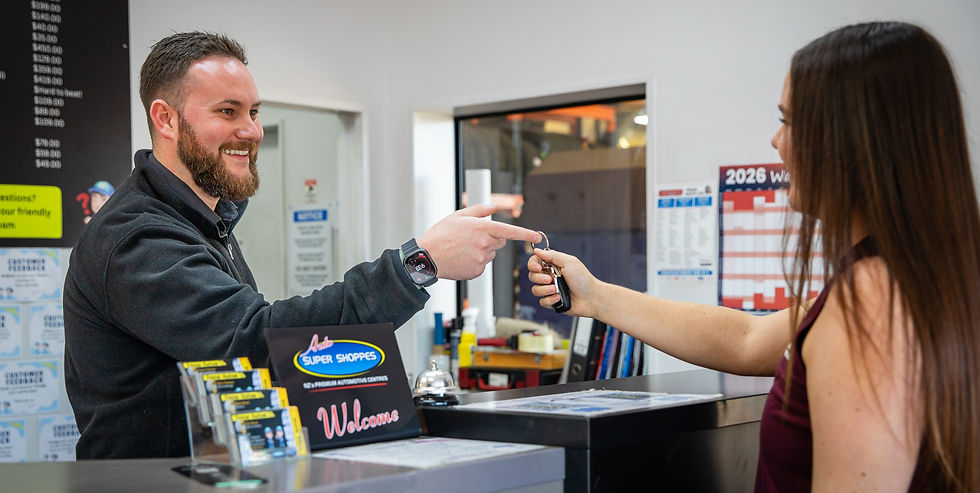
Servicing & Manufacturer Warranties
Many people are surprised to learn that servicing your vehicle at an independent qualified workshop does not automatically void your manufacturer’s warranty.
According to the Motor Trade Association (MTA) warranty servicing guidance, vehicles can often be serviced outside the dealership network provided the servicing is carried out correctly and in line with the manufacturer’s requirements.
At Tom’s Autos, we regularly service late-model petrol, diesel, hybrid, and EV vehicles while following manufacturer servicing schedules and procedures wherever applicable.
Do I need to have my vehicle serviced at the official brand dealer to maintain the warranty?
Your rights under the Consumer Guarantees Act (CGA) cannot be removed simply because you chose not to use the selling dealer's workshop.
A vehicle dealer may encourage you to get your vehicle serviced with them, however, using a qualified independent mechanic should be low risk provided servicing follows the manufacturer's guidelines and specifications, appropriate parts and the correct fluids are used and service intervals are maintained.
Manufacturer warranties generally relate to the specific component or issue involved — not automatically the entire vehicle. For example, having your vehicle serviced at a qualified independent workshop would not normally affect warranty coverage for an unrelated component, provided the servicing was completed correctly and in accordance with the manufacturer’s requirements.
At Tom’s Autos, we continue investing heavily in modern diagnostic equipment, technical information systems, staff training, and workshop processes to ensure we can confidently service modern vehicles — including hybrids and EVs — to a professional standard. We also maintain appropriate business and public liability insurance for additional peace of mind.
But there are caveats. If the independent repairer’s workmanship directly caused the fault being claimed, or any future fault relating to a repair outside the dealer network of course the manufacturer may legitimately decline a claim even though the vehicle is still in the manufacturer’s warranty period. Like any professional repairer, independent workshops are responsible for the quality of their workmanship.
Equivalent parts that meet manufacturer specifications are generally acceptable, however, if a non-genuine part fails and causes damage to your vehicle, that specific damage may not be covered under your manufacturer's warranty.
It’s worth bearing in mind that aftermarket parts providers may offer their own warranty in the event you experience issues, and the repair shop would also have reasonable obligations under CGA.
In the event of any issue, other elements of your warranty unrelated to the defect should remain unaffected. Extended warranties may have stricter requirements, so check the terms.
Do I need to use genuine manufacturer parts to keep my warranty valid?
The important thing is not necessarily where your vehicle is serviced — it’s how it is serviced.
The MTA notes that independent workshops may still service vehicles under warranty provided servicing requirements are met correctly.
At Tom’s Autos we:
-
Follow manufacturer servicing schedules where applicable
-
Use quality parts and fluids
-
Record servicing history
-
Carry out digital inspections and diagnostics
-
Service many late-model and lease vehicles
-
Invest in ongoing technical training
Independent Workshop vs Dealership Servicing?
Equivalent parts that meet manufacturer specifications are generally acceptable, however, if a non-genuine part fails and causes damage to your vehicle, that specific damage may not be covered under your manufacturer's warranty.
It’s worth bearing in mind that aftermarket parts providers may offer their own warranty in the event you experience issues, and the repair shop would also have reasonable obligations under CGA.
In the event of any issue, other elements of your warranty unrelated to the defect should remain unaffected. Extended warranties may have stricter requirements, so check the terms.
Do I need to use genuine manufacturer parts to keep my warranty valid?
Warranty Repairs vs Warranty Servicing
It’s important to understand the difference between:
Warranty Servicing
Routine maintenance completed according to the manufacturer’s servicing requirements.
Warranty Repairs
Repairs carried out when a component fails under manufacturer warranty or mechanical breakdown cover.
In some cases, warranty repairs may still need approval from the vehicle manufacturer or warranty provider before work is completed.
If you’re unsure what applies to your vehicle, our team is happy to help explain the process.
What is the Consumer Guarantees Act (CGA), and how is it different from my warranty?
The CGA is a law that automatically gives you rights when you buy goods or services from a trader - including new and used cars. You don't need to do anything to get these rights and they cannot be taken away from you, even if you sign something that says otherwise.
Any car sold by a dealer must be of 'acceptable quality' and ‘fit for the purpose’. What meets these requirements depends heavily on vehicle age, price, kilometres travelled, and the condition of the vehicle at the time of sale.
A manufacturer's warranty, on the other hand, is a voluntary promise made by the manufacturer or dealer on top of your legal rights. It typically sets out specific things they will fix, for free, within a set time period – typically containing exclusions and conditions that limit what is covered.
Your warranty and CGA sit side by side. But your CGA rights exist whether or not there is a warranty and they can sometimes cover you even after a manufacturer's warranty has expired - particularly if a fault appears sooner than a reasonable person would expect for a vehicle of that type, age, kilometres and price.
It’s important to read the fine print. Extended warranties are voluntary contracts and their terms are often more restrictive than your standard factory warranty.
Most extended warranties explicitly require dealer servicing to remain valid. They are best viewed as a loyalty strategy by the manufacturer – if you service your car with them, they’ll cover you for longer. If you don’t, they won’t.
Note that neither the factory nor extended warranties affect your basic CGA rights.
How about extended warranties?
Can’t you just give a straight answer? Do I need to take my car to the approved dealer to maintain the warranty or not?
In many cases, no — you do not automatically need to return to the selling dealer for routine servicing simply to maintain your manufacturer’s warranty.
What matters most is that servicing is carried out correctly, to the manufacturer’s specifications, using the appropriate parts, fluids, procedures, and service intervals.
That said, modern vehicle warranties can sometimes become complicated if a failure is later alleged to have been caused by incorrect servicing, repairs, modifications, or poor workmanship. In those situations, determining responsibility is not always straightforward.
At Tom’s Autos, we continue investing heavily in modern diagnostic equipment, technical information systems, staff training, and workshop processes to ensure we can confidently service modern vehicles — including hybrids and EVs — to a professional standard. We also maintain appropriate business and public liability insurance for additional peace of mind.
Ultimately, every vehicle, manufacturer, warranty policy, and situation can differ slightly. If you are unsure what is best for your vehicle or warranty requirements, we’re always happy to discuss your options and help point you in the right direction.
Once a vehicle is outside its manufacturer’s warranty period, dealership servicing requirements generally become far less relevant.
At that point, most owners simply want a qualified workshop they trust to correctly maintain and repair their vehicle using appropriate parts, fluids, diagnostics, and service procedures.
Modern vehicles — including hybrids and EVs — still require specialised knowledge, tooling, and ongoing technical training long after the factory warranty expires. That’s why we continue investing heavily in modern diagnostic equipment, technical information systems, staff training, and workshop capability to service a wide range of modern vehicles to a professional standard.
Even outside manufacturer warranty periods, vehicle owners in New Zealand still retain protections under the Consumer Guarantees Act (CGA) relating to workmanship and services provided by repairers.
Whether your vehicle is brand new, out of warranty, or somewhere in between, our team is always happy to discuss the best servicing approach for your vehicle and circumstances.
If my car is out of manufacturer’s warranty, does this any of this apply?
Disclaimer: The information contained in this document is provided for general informational purposes only and does not constitute legal advice. It is intended to provide a broad overview of consumer rights in New Zealand relating to vehicle warranties and servicing and should not be relied upon as a substitute for professional legal advice tailored to your specific circumstances. Whilst every effort has been made to ensure accuracy at the time of publication, legislation and regulatory frameworks may change. We accept no liability for any loss or damage arising from reliance on this information. For advice specific to your situation, please consult a qualified legal professional, Consumer NZ, your local Community Law Centre, or the Motor Vehicle Disputes Tribunal. If the business is an MTA member, the MTA Mediation service is free and may also be able to assist.